Naudé studied Etching at the King’s Road College, London (not far from the Slade School) for 3 months. The following etching was possibly a product of this study:

They met up with some South African friends:

Philip du Toit (1881-1957), nephew of the artist and son of his sister Catharina Elizabeth (1863-1939) and Jacobus Stephanus du Toit (1854-1925), Hugo Naudé (behind), “Cope” Krone, du Toit (ophthalmologist), photographer ?de Vries.
A letter from Emily Hobhouse to his fiancée Julie Brown, dated 3 January 1914 confirms that Naudé was back home by then:39
The Cottage
Kenilworth
Jan: 3/14
Dear Miss Brown [Julie]
You & “Yours” flooded the room with a momentary burst of the sunshine of happiness yesterday & it did me good to have that glimpse of such a radiance.
I was sorry I dared not spend my wee strength upon you then for I had promised it to another friend.
But will you come again with Mr Naudé & will he be good natured enough to bring me some of his sketches to look at, as I so enjoy it.
I want to hear all your plans. Will next Sunday afternoon suit you at 3.30? If not propose another day. Actually I can only see one person at a time or I get flustered but I look on you two as one – at least it works out so.
With love – afftly [affectionately] yours
Emily Hobhouse
A month later she is commenting on Naudé’s work:
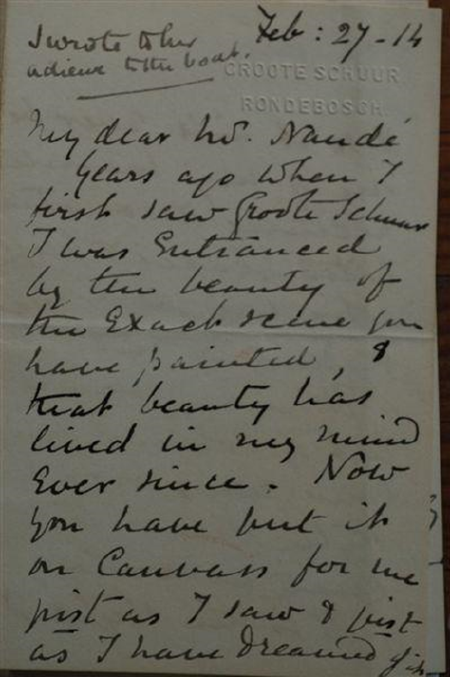
Feb: 27 – 14GROOTE SCHUURRONDEBOSCHJ [Julia] wrote to her
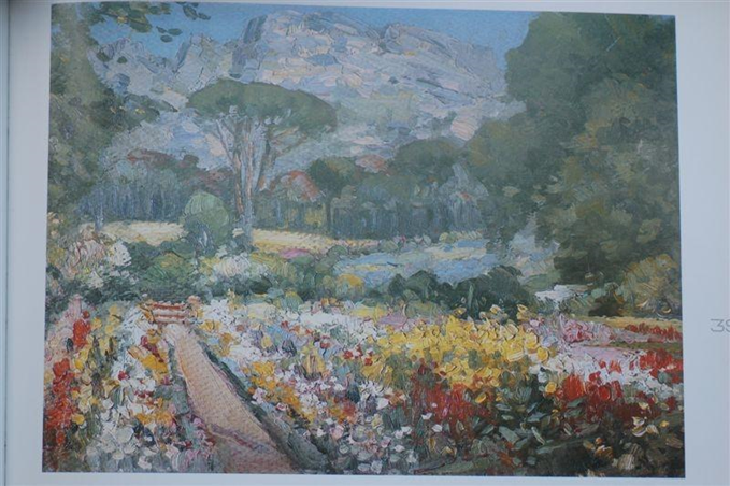
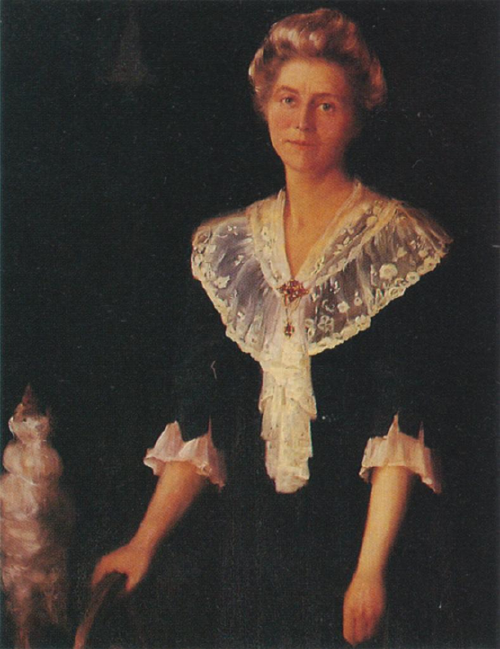
on drive to the boat.40My dear Mr NaudéYears ago when I first saw Groote Schuur I was entranced by the beauty of the exact scene you have painted, & that beauty has lived in my mind ever since. Now you have put it on canvas for me just as I saw & just as I have dreamed of it & so it will ever be one of my favourite pictures, associated with places & people who are very near & dear to me.It is a glorious bit of colour and your new broad style shews to great advantage [picture presented below].It is the style I always longed for you to adopt when you were painting my portrait in Pretoria [picture presented below].Mr Botha is also very pleased with this sketch – do not fail to come & call on him when you are free to come up.Six hundred people will be here today for a garden party & my practical mind so wishes you could be found sketching in the grounds with ½ a doz finished sketches beside you. I feel you would have reaped a harvest & become better known to crowds who do not go to Exhibitions.Next year you must try to be on the spot when the buying public is here - & work for Exhibitions in winter days.I shall look forward if I have any bodily power in London to visiting yr. show in Bruton Street which was my old home with Lord & Lady Hobhouse for so many years.It was a delightful moment when your Julie brought me the picture yesterday.I shall hope to find amongst those in London a bit of Table Mountain or a Veld sunset – & I will try to take many people to see yr. work.Now I will not detain you from your easel to read any more- but with very best wishes for Love & ArtI remainYours very sincerelyEmily Hobhouse
Emily Hobhouse’s letter from 6 July 1914 suggests that they were married in 1914 and not 1915 as is widely written:41
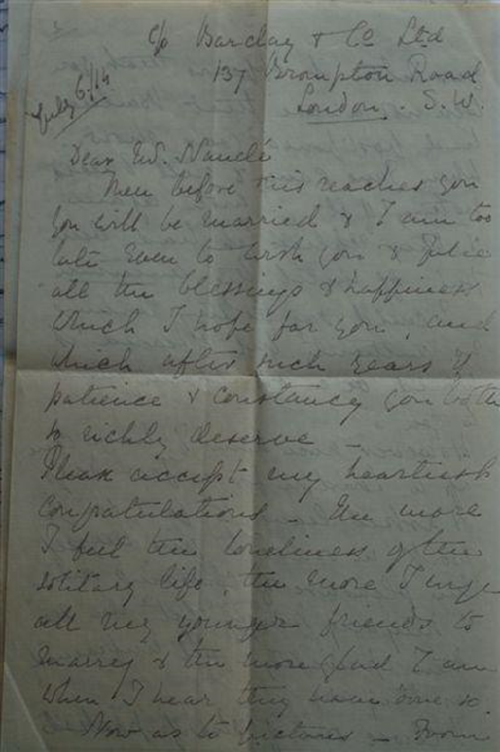
c/o Barclay & Co.Ltd137 Brompton RdLondon. S.W.July 6/14
Dear Mr Naudé
Then before this reaches you you will be married & I am too late even to wish you & Julie all the blessings & happiness which I hope for you, and which after such years of patience & constancy you both so richly deserve -
Please accept my heartiest congratulations. The more I feel the loneliness of the solitary life, the more I wish all my younger friends to marry & the more glad I am when I hear they have done so.
Now as to pictures – from your letter it appears that you were not aware that Baillie had postponed your show.
When June came & still I heard nothing of it, I wrote again & they replied it had been put off until the autumn.
I could say nothing having no authority but I feared it would be a disappointment to you -
However since then I have come up to London for a few days & asked leave to go & see yr work in order to give myself the pleasure of choosing one, & they very kindly let me see them privately – all unframed as they are.
I chose one of sharp peaked mountains, with a strong light on them, which seemed to me characteristic of South Africa, and I shall value it very much as I do all your work.
I was relieved, on the one hand, to find that you had not lent any of your important work to London, only these small sketches, because it will not matter so much, the long postponement of the show -
On the other hand I was sorry that your first show in London should not contain any of yr serious work – portraits – larger landscapes ?etc: Perhaps later on you will collect enough to send over under the fresh inspiration of married life!
I do congratulate you on this great & interesting work of painting the two dead statesmen, but how difficult to reconstruct from photographs.
I should love to follow this letter into your charming Studio home; I must content myself with picturing your happiness - which I hope may be deep and lasting
Yrs ever affectly
Emily HobhouseBaillie let me carry off my purchase because he said he had more than he intended to hang -
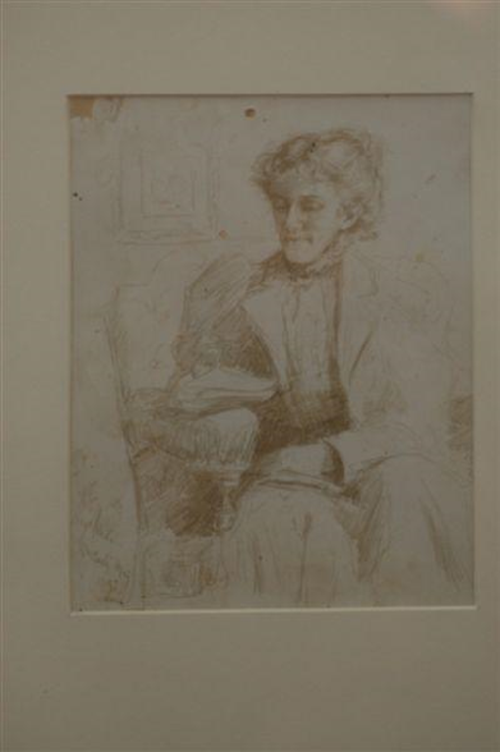
Julia Mary Brown (18 March 1877 - 28 December 1938) was the daughter of Dr John & Mrs Mary Brown of Rosebank. Her mother, Mary née Solomon (1847-1935), was a remarkable lady to whom Olive Schreiner (alias Ralph Iron) dedicated The Story of an African Farm (“To my friend Mrs John Brown of Burnley this little Firstling of my pen is lovingly inscribed”) in 1883, and to whom the Afrikaans writer M.E.R. devoted a chapter in her book My Beskeie Deel:
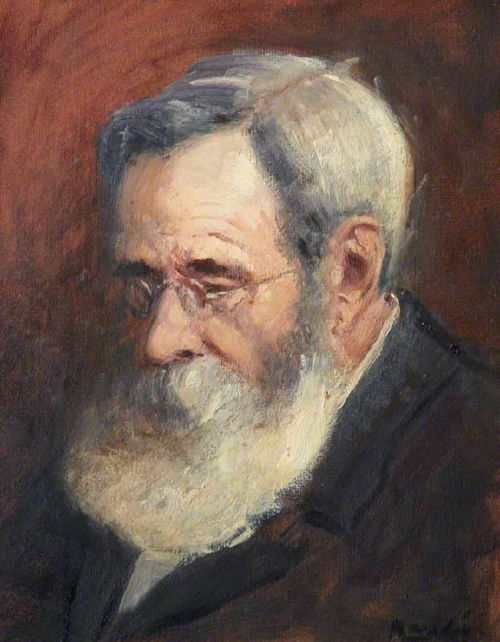
Naudé also painted her father Dr John Brown (21 July 1842-1929):
Pieter Hugo Naudé and Julia Mary Brown were married on Thursday 23 July 191442 at St. Paul’s Church, Rondebosch in Cape Town:
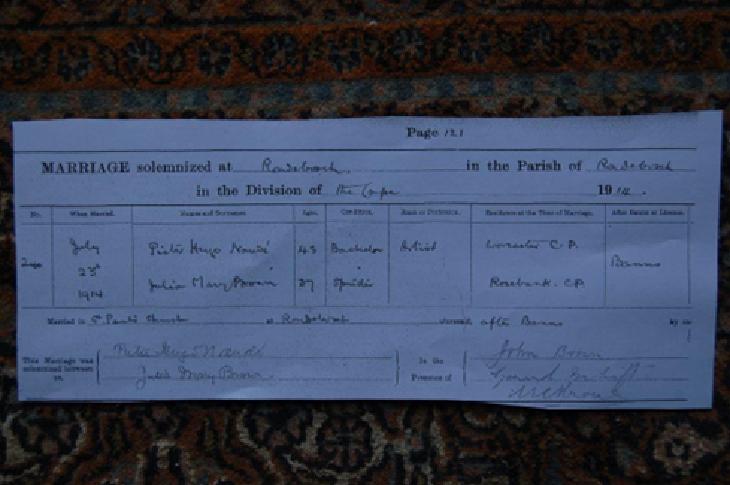
Their ages 45 and 37 on the marriage record confirm their years of birth: 1869 and 1877, respectively. The Brown’s place of residence is noted as Rosebank, and not Mowbray or Kenilworth as repeated in the literature. John Brown, Gerard ? Swift and NC Krone are listed as witnesses.43
Aunt Julie was devoted to her husband, most encouraging & enthusiastic about his work & she organized her life subsidiary to his interests. She was a trained nurse & was instrumental in getting a clinic started for the [local] people of Worcester. As you know there is deservedly a crèche for [local] children bearing her name. She found time with her Braille press to print books for her many blind friends.44
- See forthcoming Appendix A for photo of original letter.↩︎
- This note is probably the Artist’s handwriting, indicating that Julie delivered a painting to Hobhouse.↩︎
- Wikipedia, previously, had incorrectly claimed that he married Heloise Naudé, who was not even born yet and was Curator of the Kleinplasie Museum in Worcester during the 1970s and 1980s. Thankfully Wikipedia removed this posting from their website.↩︎
- Not 1915 as is repeated in the literature. The artist’s best man, N.C. Krone, in his “re:HUGO NAUDE” (Brown Family Papers BC597 A66, UCT Libraries’ Special Collections) gives 1914 and Julie’s niece, Mrs Mollie Earle recalls the correct year 1914 – see forthcoming Posthumous Conclusion and Appendix A.↩︎
- Many Thanks to Arlene Christian, the Secretary of St.Paul’s Church for checking their records and emailing the scanned document to me (email of 9 November 2020).↩︎
- Talk by “Wollie” on behalf of the Naudé family at the opening of the Hugo Naudé House on 10 August 1979. [local] replaces the derogatory “C” word and reference to “non-European”.↩︎