You feel secluded like on a ship with so much light and space around you; even the little clouds which glide past make you feel as if you float away with them. It helped a lot to pass the long time sitting on a straight-backed chair on the small platform.
Of course there were times to stand up and stretch the legs; and as the portrait progressed so did I become more involved with the man who painted it. He was reserved by nature, and because they did not have children of their own, perhaps not quite sure how to talk to a 9-year old girl. At first I was amazed to see how he created me with paint and brush; the same hair and blue ribbon which went with the blue sailor collar over a white shirt, both eyes, the nose, chin and cheekbones. But as time went on, we both became less self-conscious and tense in each other’s company and here it was mainly Julie who bridged the discomfort. The timely tea breaks were therefore more than welcome when she ascended the steps with a tray and we three could relax. Not long thereafter I was also invited to go with him and the brothers to the veld; no longer a problem but one of the gang.
When the portrait was almost complete, Pieter said one day: “When you marry one day, you’ll get it as a wedding present”. Well, at that time one forgets such things because marriage is still a non-event. The portrait went to various exhibitions but always came home again. He completed other portraits on commission or by choice and sold to the parties involved. He was a portraitist par excellence and primarily studied this in Europe but he also absorbed other influences and later in his own country also painted landscapes and other scenes with dedication. Fifteen years later on the eve of my wedding day, Pieter handed over, as promised, the portrait wrapped in a piece of brown paper under his arm. To this day I still regard it as my most treasured possession.
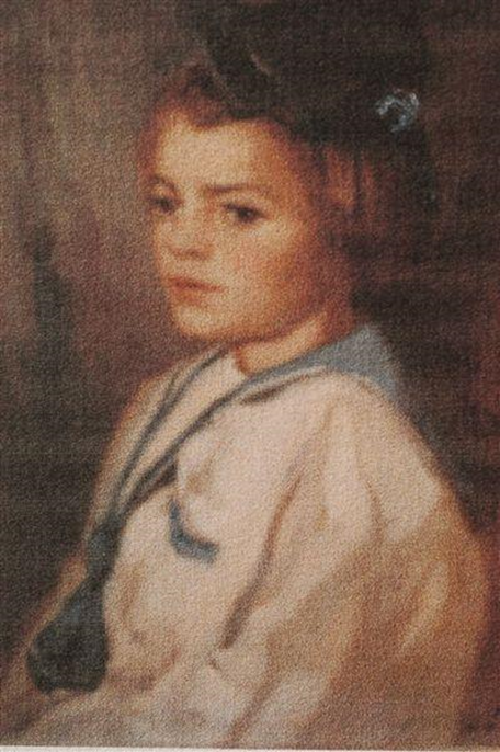
When I received it, I could not, with the passing of years, confirm from my own memory whether the child in the portrait was a true portrayal, and whether he noticed what others saw in it. Only when my own children and even some of the grandchildren showed similar features at that stage, could I accept that it must have been an accurate interpretation of the innocence that children at that age experience. It was also invaluable to me because I could take it everywhere with me to where I set up home after leaving my home town for good. To me it was an existential affirmation from the past. This connection with my childhood years strongly supported me by reminding me about the values which I learnt there and served to keep me on an even keel and enabled me to move forward with few noteworthy injuries.
The understanding and support which we experienced as children from Pieter and Julie was also available to other young people. They were actively involved with the town children in the Scout movement48 for a long time and contributed enormously. Many young artists visited Pieter. They often stayed over and never left without advice and strength, often given financial assistance too, even though they weren’t very wealthy. Pieter believed strongly that an artist must have a backup career to give financial support, especially when still a young beginner. He himself had to use available means for his studies and it took a long time before he received recognition. How many paintings didn’t he sell cheaply in order to survive. In addition he was generous and easily gave away his work for free, like we take cake for the neighbour. He was too critical and unsure about his own work. On one side of his studio he cordoned off an area which he called the “Chamber of Horrors” and everything which he was dissatisfied with, landed there. He often said that those canvasses must be burnt one day, but some of his best works were found there. Julie was the sensible one. Just as she was gentle and loving, so she was strongly disciplined. Her social work where she helped manage a clinic for the [local] community and her earlier experience as a nurse made her realise the importance of having definite goals: she and Pieter earned a living from the paintings and therefore the paintings must be sold as much as possible. I will always remember how, when I was a student studying on loans and bursaries, Pieter and Julie quietly put away a sum of money and called me in to explain that it must be used to complete my studies while they were still alive. They had decided to name the sons of Pieter’s brothers their heirs, but this was what they wanted to do for me.
Some of the best memories were the outings we enjoyed together. I remember the warm summer evenings when we went with the adults to picnic alongside the Hex River and how the unpolluted water quickly flowed over the round white stones past the damp vegetation. I remember the evening food of salad and fruit and especially the relaxed conversation until the early stars came out. Other days just us children went camping with Pieter for the day in the veld. While he walked further into the veld or went climbing in the mountain kloofs to sketch or paint, we stayed behind and prepared a picnic. The boys made a fire in a safe place and when the coals were ready to braai the meat, we’d put the black kettle on as well to boil water for coffee. When he returned, he usually brought plant material back with him – Leucadendron spp. [tolbossies], Stoebe spp. [slangbos] and succulents for his garden. The foliage was for the yellow stone jar at home which he arranged himself on the bookcase in the lounge, just stick in and straighten, finish & klaar.
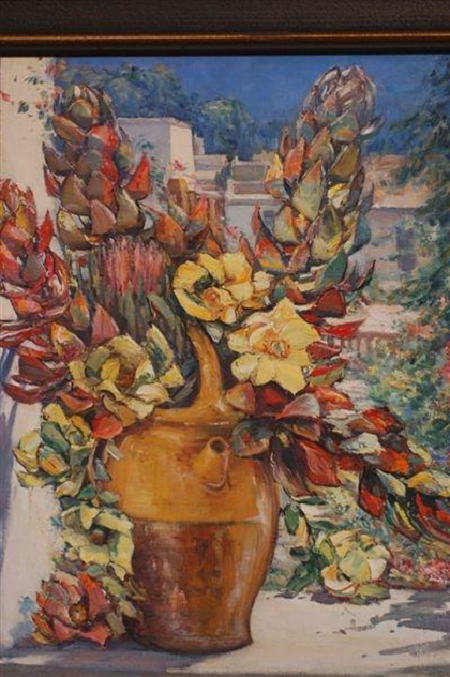
After such an outing we would perhaps gather later in the year on a winter’s evening around the fire in the studio.
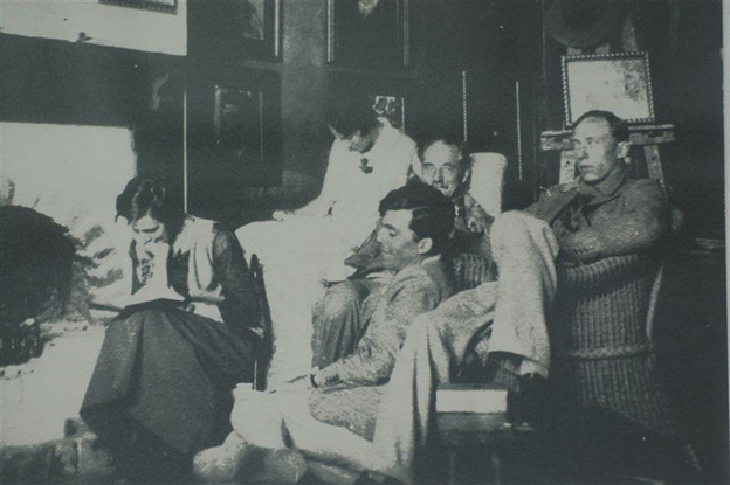
Often we’d sing merrily together around the piano while Pieter himself would play some of his old student songs. It struck me how confidently his broad fingers would reach the notes accompanying the singing, whilst my eyes roamed over the completed paintings on the walls, and I admired the utter beauty which those fingers created with a fine pencil. Specks of scarlet paint become Jerusalem Poppies:
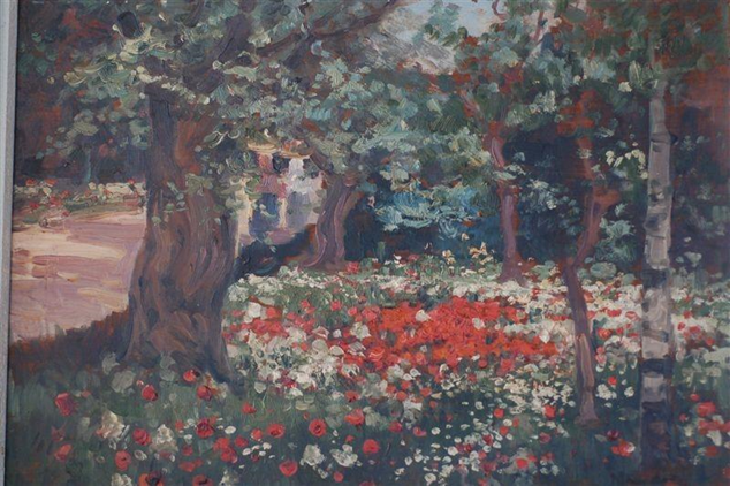
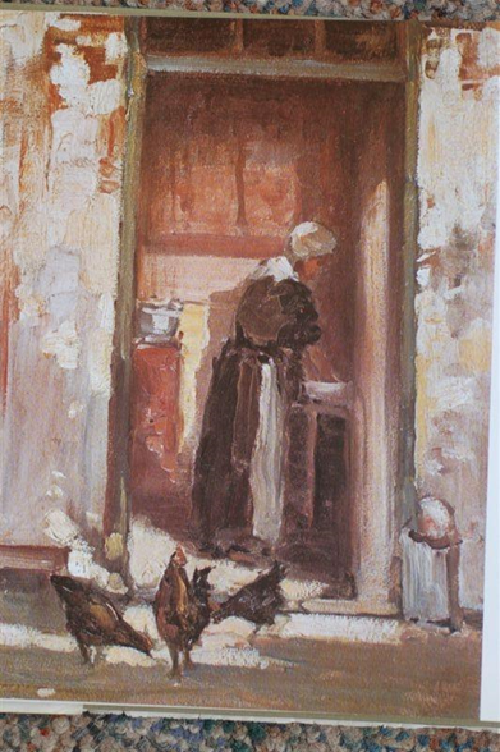
elsewhere they depict a red hen with her chicks which scratch in front of the open door of a labourer’s cottage;
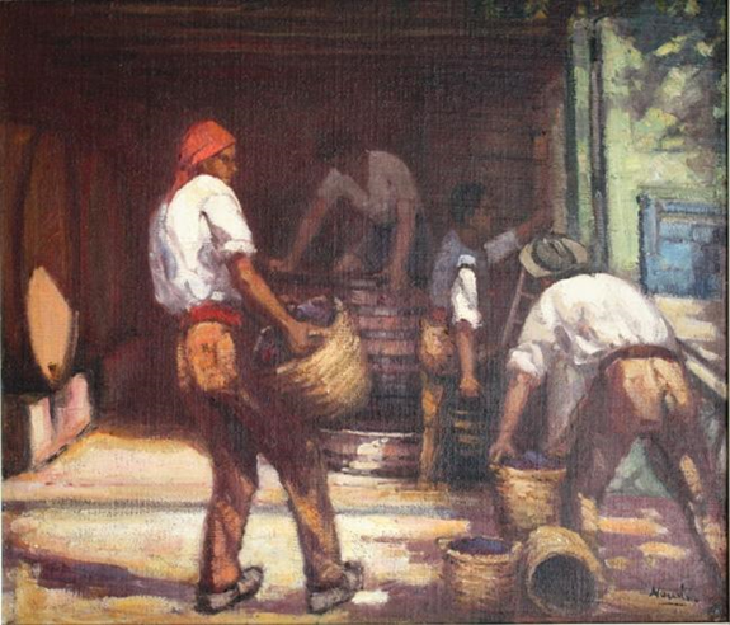
wider pencil stripes straight down and across create a farmyard with labourers around the wine press
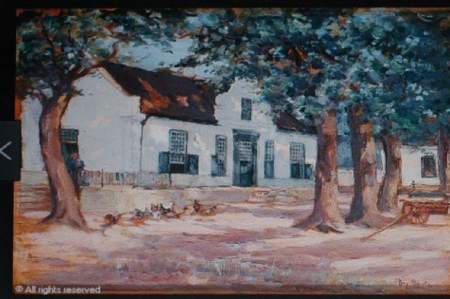
while bright spots of light in between the trees create the illusion of a warm summer’s afternoon around 12h00 when the farm bell has rung and the workers can relax under the high coolth
Continues…
- The Afrikaans for Scout movement is “Padvinderbeweging” which is so apt for an artist pioneering a path for those who followed - a scout or pathfinder.↩︎