In the following letter from the “Artist” to “Wollie”, we again read of his concern for others and being cheerful, despite his deep grief:
The Studio Feb 3rd/39.
Dear Wolly - Scott the head of the grass section of the veld reserve in Gov. employ came down to inspect the Reserve as well as meet Mr. P. Evans here. Then I thought I had a brain wave I asked Scott to try & get the old man down to see me – for I wanted him to give you a job. He did come & I saw him for a few minutes. When I tackled him he told me that a Naudé had applied & that they particularly liked his accompanying letter & seemed on the whole favourably impressed.
Paul Evans is a close card & lets nothing commit him but I think he is thinking about that post of Grahamstown. Anyway he promised to do his best – so the wind had been taken out of my sails – still he knows me - & knowing that you are a nephew of mine it may help – who knows.
Scott is also anxious to have you in their reserve research employ. Do I see a big bit of future sticking out??
Tea intervened & letters. Ch. Leipoldt (Dr)55
came down a couple of weeks ago to gather information about me & my work (tiresome to a degree) & has sent me a cutting of the (Die Volkstem). He evidently wrote the article because of the kindness & praise - the Academy of Arts ? Joh’burg is supposed to have recognized me as worthy of their notice & recognition.
Leipoldt is writing an article for the Huisgenoot so I am in the limelight. Just now when I feel that nothing seems worthwhile & there is a vague indifference to outside things. I have lost my bigger half of my being & the rest seems not to have come to real life again. Yet it had to be & that seems the cruel fate. I’ll have to begin again in my old age to look at things by myself without that comforting inspiring aid & main spring. To the outside world I am my happy old self - & I am not really sad deep down, but you won’t mind my letting on a bit. You know these last 5 weeks seem to be a long piece of time – will it go faster as time goes on?
It will be nice sometime to welcome you & your dear mother here in my home.
I am beginning now to get things in a simple working basis. I am anxious to practise economy. Is it possible to a Naudé, do you think? I have Alec Fenton here living in one of the boys’ rooms. He is very happy to be here & I am glad of his quiet effacing manner, but I now pull him out & he is responding to things that matter at the studio. I have never been alone & everybody has been kind & loving. I wonder are you & Lala going to Natal – I was sorry you weren’t here to meet Paul Evans, he asked to see you – but I hope it won’t make any diff. I am very busy repairing & cleaning the house – Julie’s room has been thoroughly done & looks bright & fragrant; fit for her memories to dwell in – she’s everywhere & that’s why I would not go away to places where she was not connected with. When you come up this way know that your little spot is ready & so for Lala.
My love to them all. Evryrs
Oom Pieter.
The Studio. Wednesday [13 V A39 Waschbank postal stamp]
Dear Wollie
I am so glad that you have at last got to the spot where you can get your first jump-off. I hope you will be happy, & become a famous Civil Servant with a fat pension at the end of the career. I am late in writing for I hadn’t time to tell Pierre de K. what you were up to - so I gave him the letter to see for himself & you know how time goes & I have only just got back the letter. Pierre is teaching in the Boys School for a term. So I have him here often & he helps with the Scouts.
What a pity you couldn’t come to Worc. It w[oul]d. have been lovely to have you here for a fortnight.
A young fellow from Cradock is staying here for a couple of months to try his hand at becoming a painter. Van Heerden is his name & has talent & can draw things out of his head etc very well indeed – but I advised that working in Railway perhaps the advertising dept. will help him to earn a living & there will be plenty of time to paint ?miles of (our ones un wouted anyway. So he has applied.
I would have liked to accept Alwyn’s56
kind invitation to come to Waschbank, & I wd. have liked to see his garden on farm – but I am ?thraged here right enough with endless duties & little things to do of no real value.
Tell him I shall come one of these fine days.
Keep me in touch with your doings. I am terribly interested. Give my love to yr mother & Alwyn
& believe me of course to be always your devoted
Uncle Piet.
The Studio
14th/Sept./39.
Dear Wolly.
Months & weeks seem alike in their flight - & nothing much gets done yet one is always terribly busy.
David just now rang up from the farm & asked to come over for the weekend – I am glad. Piet & I are very lonely or rather quiet – Abe is away seeing girls or skiing in the mountains even when there is no snow. I don’t know whether you know that brother in Franschhoek died lately & the place is sold & Fanie has no liabilities left now in connection with the property.
I was told that you are trying to get a spot in Maritzburg in chemistry so that you can work for yr. Dr.degree – Is that true & are you going to get the place?
Piet & I are at the table near a fire – the weather is still very cold. I am doing some of my neglected correspondence & sending cheques for bills – cheerful!!
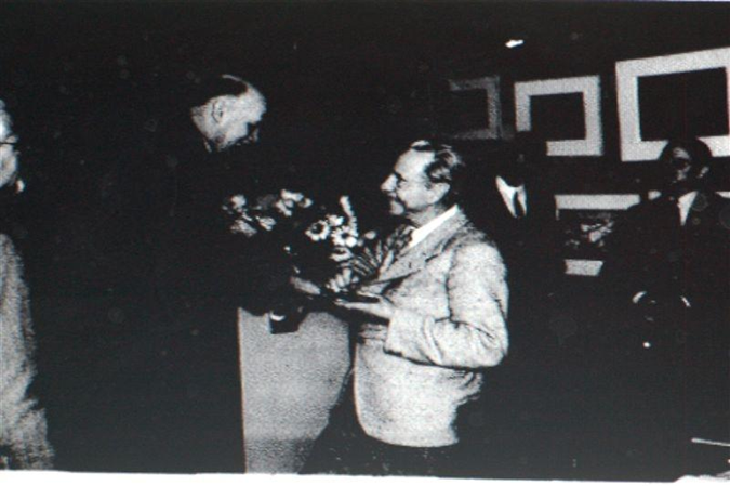
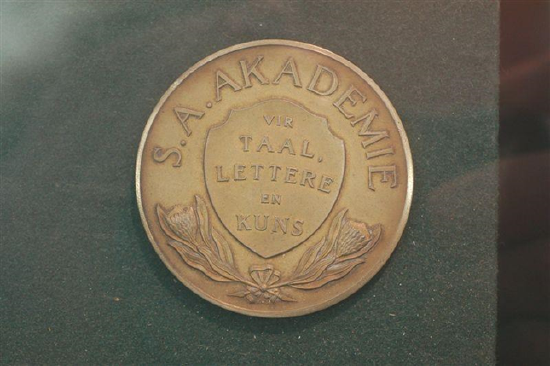
Perhaps you have heard that I had a most successful show of Prentjies at Stellenbosch in the Carneggie Bibliotek & did jolly well. I sold two picts.of 50/. & one of 30 – thirty four in all at good prices not withstanding that war broke out before I finished. They saw that they have never had so fine & interesting show at Stell. The attendance & interest was great. I also received a large gold medal from the Akademie van kunst en Letterkunde:57
So for once I felt big & strutted about among the youngsters. They were specially interested & nice & came constantly. I wish I c[oul]d. get hold of a studio or room suitable – then I w[oul]d. work there periodically. That’s to say if the fellows will let me. I could do a lot of head studies. Dreams – what?
I hope you will get this – you may be away in the veld. I get so few letters now that I shall soon forget how to write. Nothing much happens here – people annoy me as much as ever. Other’s nobody about much. The place is deadly dull. Mostly new people that one can’t or won’t meet - & now the War is on & everything seems to be miserable – I can’t stand suffering about me.
I hope our Afrikaans people will behave themselves.
A lorry on its return from a war-protest meeting, fell off Breede R. bridge & killed the owner & one son & injured the others. So the world goes.
Keep well & let me hear soon of your plans for the future.
Ever yours. Uncle Pieter
On 15 November 1939 the Artist signed his Last Will and Testament (see forthcoming Posthumous Conclusion).
The Studio.
July 11th/40
Dear Wolly.
A friend gave me a lift home this evening & asked me whether he heard correctly that you had joined up with the forces for fighting.
I have not heard from you since ’39. My fault I know - but while your Mother was here I knew all about yr. doings. Since then the time has flown & I am amazed to find month after month slips bye so quickly that the year is already half spent.
Send me a line if you get this. So that I can know where you are & what. I was interested in all you c[oul]d. tell me – here nothing unforseen happens - ? ealipting in the War. Then it is always the unexpected that happens. What is going to happen unexpectedly here in S.A. none of us know – things are pretty sickening & I have no more patience left with our people – But we must not talk about this just now – I am depressed about peace actions & the rest.
Poor Hugo I am sorry he can’t go on with the Town Hall job here. It will of course go forward as soon as things are fairly normal.
James du Toit who is Mayor for a short while told me that the money they set apart will be there safely until such time as needed to proceed – but material is enormously advanced & they c[oul]d. not think of doing the job now. The old Council had got into such a scrape now that they had to go. Gie had quite imagined himself a ‘dictator’. He worried me no end too at the garden. Keyter has also planted a rose garden on the square – close up along the bluegums – about 4 feet away fr.[om] sugar farm. 500 rose trees wasted & they have no money to get the Garden of Remembrance at least made into decent order.
Now by working ourselves we have the terraces started & the wall on the outside of small stones, will come too, to complete the Garden at last.
Abe has gone off to the front & is at Potchefstroom-?Gunnerteaton. Ed Minnaar is passing through here en route to Transv. also joined up & keen to get there. Basil left this morning for the Heights.
Piet v. Heerden is still here, working for his Matric & doing quite well. He has improved in his drawing & painting too. He is taking Art instead of Maths. Have you met him. He came to me in April of last year.
I don’t know what yr finances are & how much of a ‘screw you get – thus far I am allright, but Art will not be wanted soon & I must warn you that you may have to pay the interest on our little loan yourself - £6- a year. We pay twice a year - £3 – a time.
The £100 we loaned will probably be paid out of my Estate after death, if there is to be any Estate. So if you can do that I’ll be glad, for Piet is dependent on me & I want to see him through Training College with special Art training.
[vertical down LH margin]: Lala met Piet here & knows all about our little schemes. He has been a real godsend to me & a pleasant companion. Write soon - & tell me where you are & all that. Yr Uncle Pieter.
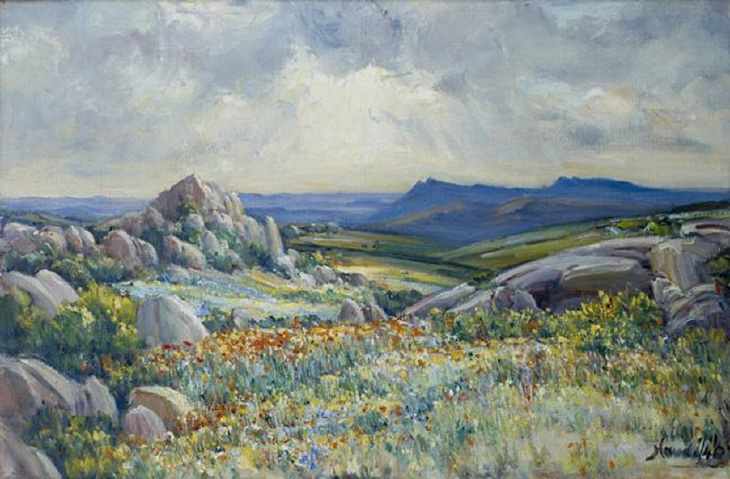
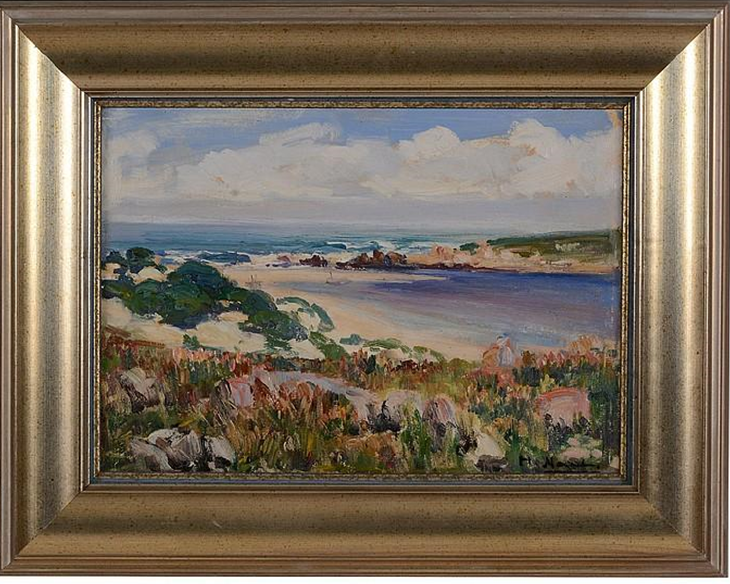
The following painting of Namaqualand is dated 1940:
Signed and dated “Naudé ‘40” lower right, oil on canvas 40 x 60cm (Johan Borman Fine Art, 2009).
He spent two weeks at the start of 1941 camping at Hermanus (see letter below).
His final letter to “Wollie” reads as follows:
The Studio.
Feb 18th/41.
Dear Wollie.
Thanks for your letter and cheque. I am glad you could help with paying for the interest. I am starting Piet v. Heerden in the Mowbray College for Training as an Art teacher in the premiere schools – In that College under W. Pienaar specialise [sic] in this training – after the Canadian principles. This will suit Piet very well & secure another means for bread winning that pure Art. That will not pay after the War & artists will probably have to be prepared to give away their work like men of means! He, Piet, passed his Matric - & there is another period of ?6 years for me to help him through. Faith & hard work will be necessary. The boy is very gifted – draws very well - & has done some quite unique oil sketches - of which I have sold quite a number.
All this makes life very interesting & full. I am a little lonely without him here, but one of my older scouts is practically living here – still at school, his home is in the town so I am not wholly responsible for his keep – but his sleeping here & coming in & out make things pleasanter.
I am keeping very well – getting older & looking older, but get through a big lot of duties & work – my life is not dull by any means.
The elder Schonken58
girl has come home, & is looking out for a job. We had a long talk & she wanted to know all about you – a fat lot I could tell her! Still I knew that you were engaged in war work etc & that is all. I saw Lala in Hermanus where I camped for a fortnight. She looked well - & is still away. Nothing has changed here at all – the people are charming to me & I am discovering my relations one by one.
James & Muriel (Mayor & Mayoress) both doing their duty well – J. makes a very useful Mayor & things are running smoothly now.
Phillip Dalla & the girls see more of me now that I can go out more – don’t you get leave like the other blokes. They seem to be coming home at all sorts of odd times. You’ll find a very warm welcome and a nice time if you come. I have a lovely Phillips Radiogram – a beauty. Now we can have fine orchestral music - It helps to keep the War depression down. There’s a long list of Old Scouts - & boys that I have come in touch with at the Front. In the Anglican Church the names are read out & prayers said for them, so I go to that church for there one may pray for the men in our Church. Mr Murray gets anonemus [sic] letters threatening him when he prays for the ‘King of England’. So that is that – The world goes round & we & England with it – so we‘ll see what we will see - Much love Uncle Pieter
Jean [Johann Max Friedrich] Welz (b.Salzburg, Austria 1900 - 1975) met Naudé after Nancy Dick (Julie Brown’s niece and social worker) heard of Welz’s plans to move to Stonehaven, Tradouw Pass and was aware of his artistic talent – she gave him the Worcester address of her uncle, Hugo. “Even though the dry air of the Tradouw Pass made a positive difference, Jean still suffered with chest complaints. In a letter to Hugo Naudé, Inger explained their situation and asked if he knew of a doctor in Worcester whom he could recommend. In a sympathetic answer, Naudé invited Jean to visit him. Adèle Naudé recounted the meeting:
On a trip to Stellenbosch to have his work assessed by Dr Bouman, a stopover in Worcester on the return journey by train was arranged. As the train drew in, Jean says, he was absolutely amazed when a [local] man, Tilla it was, singled him out on the platform and said: “This way, Master.” “No, no,” replied Jean, thinking there was a taxi waiting, which he could not afford. But then he found the “lean, elegant, nonchalant” (Jean’s words) artist sitting outside in the caravan.59
From the start, there was a remarkably good rapport between Jean Welz and ‘Artist’ as Hugo Naudé was called. They talked, listened to music, worked in Naudé’s rock garden on the town square and examined the paintings which had been packed away in Naudé’s ‘Chamber of Horrors’, a partitioned corner of his studio. There were about 150 works ‘with all the freshness of the countryside depicted on them’”. They went to look at Tweefontein cottage and Jean returned to his family ecstatic after his week-long visit to Naudé60
– this was the first and last time they met.
Amongst the Brown Family Papers, are letters from Naudé to his sister-in-law, Rachel (“Ray”) Dick during his last months:61
The Studio.
Sunday Evening
Dear Ray –
This week seems to have gone very fast. Preparing a couple of pictures for the New Group Exhibition62
has kept me occupied & the time has flown – ?and it seems ages since I spent that lovely time with you when Nancy left.
Tonight I am sort of wanting ‘my own folk’. I have heard nothing fr. ?The baph or Piet - :) [or abbreviation for ‘therefore’?] - I am rather lonesome. Wilfred is ?sweetness itself & is here most of the time – but we had a French man – I believe De Gaulle’s representative in C.Town. He speaks little English, but his views, that one can guess from a few words & gestures are interesting & rather upsetting. He has great faith in France? & is certain that Britain & De Gaulle are really one, but P. is under pressure of the Germans – but he is firm, & ?A d. Warlam will never give over the navy & unless Hitler takes it in a fight & that he can’t hope to do.
We want to come to town when you will be there, in fact we can’t leave here much sooner, for Rev Tattrail [Tattersall], Julie’s old friend, asked to come in ?for a few nights’ stay. He comes on Monday & we’ll take him back, Friday & be there to meet you - Miss Sinclair was very interested in Piet’s concerns & offered spare tea set that was very in the way (had been bought by a part who lives in her house). P. is delighted & feels he is already on the way of housekeeping & if he cd[could] but find a ‘house’ or room. Eve Evan knows of a D Kanty in Kenilworth Road that used to serve as a tailor’s shop that would look ?asoh [tear in page] – when you get home we’ll discuss these matters - ...[tear]...
I came home in time for Baden Powell’s Thanksgiving Service – But I was relieved when had not to go to Town.
Mr. Sugget arranged a very fine service in his church – spoke beautifully & the service was a great success.
Somehow the enormity of the whole business does make me feel helpless & depressed. Who can come along & put this hopeless world to right.
All ones own desires & ideals seem to matter so little, & yet I am to deliver pictures & one hardly has the courage to produce them.
How has Piet behaved himself, has he attended to his own feeding? I have not had a word from him.
P.C.’s [postcards] will do, only when you are alone & quiet mostly one thinks & fears all sorts of silly things.
I have to hand in the pictures on Saturday or Friday week – Exhibition opens on Wednesday. If I bring them in on Saturday then I can hardly stay until Wed. for the opening. Perhaps if P. comes with his friend then I could come in on Sunday Ev. with them & let Gawie fetch me on Wed. after the opening. I shall have to see to things & have still a few days.
Things are quite normal & nice here. Don’t worry about me – I sometimes, when not too busy want you people – for ?tea. Hugo
Monday Ev
[March 19 - 41]
Dear Ray
Outwardly in bed! Flu with ?Autrium complications. ?An this sounds interesting & dangerous but Dr is trying to disinfect the autrium (how does one spell these out-of-the-way terms?) so I am not allowed to eat meat or eggs, no proteins. Drank a lot but that does not fill – I have grape juice & lemon with soda & some scraps of light solid nourishment – so don’t think I shall starve – I had this trouble before – a sort of combination of flu effects –
But I not very ill yet – my niece ?Brynie is probably coming to be with me for a few days – Mrs Krone threatened to ‘collect’ me & take me to her home - ?Ampera she’s coming tomorrow to turn some collars on my shirts & to darn socks –
I ?held quite a drawing room hue this afternoon at dusk – fainting all the time for some food. However, ?Frannee has just blown in & is coming for the week – so everything will be O.K.
I had a nice cheery letter from Nancy – she speaks of grand gramophone concerts better than I can do – I am glad I forwarded Piet’s allowance today so now he can pay for his books etc. Goodnight Ray dear to you [illegible]
?love Hugo
The handwriting in the above letter is less legible than his other letters.
The Studio.
Sunday. [March 23/41]
Dear Ray – It is the end of the first day out of bed & I am tired, but don’t want to go to bed so soon.
So I’ll have a little chat with you.
Basil came as usual this afternoon & we heard the services & the music. The Archbishop’s talk was good – but what a mix-up we are in. Now the Balkans & the Atlantic. How can one keep faith & be bright. Poor Plymouth & what about the rest of the towns – to be taken in turn. Light bombing can’t be stopped – not yet – I am anxious about the youngsters as you are about yours – what is to become of them? Even us! They say we’ll go on supplying things & that we’ll be allright, but Art fills no necessary place that I can see – There again God calls & we must do in good faith what He bids.
Ray cd.[could] you imagine Julie here now & all this misery. I suppose she wd.[would] have bravely stood up to it & helped. I often wish she was here for ?Easter.
During the week I had Le Roux Smith & his wife Junita for lunch. I had to stay in bed – they managed very well with ?Brynie & Lisbeth & we had lively talks. They were very funny about their father Ian Smith – second in command of the ?Ob. That unfortunate remark of his that they wd have to use the shambok on the Afrikaner if he does not organize & obey orders, has brought him quite a row of shamboks suspended in his office – I told them to ask for one for me – I need it for ?Tenfel when he is naughty. They are distressed that he has taken that job – but also take it very lightly & laugh about it all. Any way he is very nice to Junita. The boy has a bad time on both sides – being strongly pro-British & the son of his father.
The Scouts went to Prayer Service today & other units as well. The little church was over full. If I feel up to the mark I shall come to fetch Piet & take back my pictures – but then I shall not come again for Easter Vac. I don’t feel very fit yet – but then I have a week to pull up in – Love & so long. Hugo
The Studio
[Monday] 31st March/41.
Dear Ray,
It is very nice having Piet. He came home like son who belongs here, & talks of coming home quite naturally - I am glad that he can be happy here & his life is giving him great pleasures. A good deal of that he gets from your home. He seems to love going & being with you & Marg. There too he seems to belong. I shall fix up his money affairs satisfactorily before he returns. –
We went out to paint this afternoon & fetch grapes at the same time. The afternoon was perfect – but I had forgotten to tell Wilfred to bring my paintbox & he didn’t know quite. Still I studied & drew my subjects – found several which I shall most probably tackle on a large scale. The light & colour of it was so wonderful – P. remarked that the mountain seemed chiseld [sic] out of rock; which it really is by rain & wind – bare & stark & aweinspiring.
I am low in fresh pictures & must put in a spurt & do things outside.
These places are only ¼ hr. away by car & easily got at. I shall have to cut out some of the things that keep me from going – now that I am well again I shan’t be bothered by that anymore. The difficulty is that everything turns round me as like a pivot - & I live in the centre of a small world that demands a good deal, for all its smallness! Of course I get tired sooner now – even holding my palette for long wearies & makes my heart feel queer – so I have to go easy – I shd.[should] amongst other nice things come to paint in C.Town for a spell – there again it is the difficulty of getting about & carrying your material etc. Here are enough ?in are conscience to paint – but houses & Town life draws sometimes, & missing with other artists. Piet discovered a very clever young Belgian Artist – did he tell you – He is trying to get him here during the Easter vac – the long weekend -
The ‘Artist’ died suddenly from a heart attack at his residence, “The Studio”, on Saturday morning 5 April 1941 in Worcester, aged 71. His funeral at the Dutch Reformed Church on Sunday afternoon 6 April was filled to capacity, not an empty seat to be found. The Rev. J.S. Murray and the Rev. Canon F.L. Sugget officiated. The pallbearers were eight of his former scouts.63
Joan concludes with the following in her tribute to her Uncle:
But later, when he had to stay behind on his own, he bravely fought his loneliness and everyone faithfully supported him. And when he was buried a few years later, the same friends and family who supported him through Julie’s illness, also paid their last respects to him.
A photo of their grave taken by Helen M. Walters is in the glass case at the Hugo Naudé Studio. The graveyard has become a gangland so it was too dangerous in 2019 to visit Block C at the back of “Ringmuur Suid regs 13” opposite the grave of Wouter Hugo Naudé C-13-18. In 2020 the graveyard was secured and a clear photo can be found in Posthumous Conclusion, forthcoming.
[“In Loving Memory of Hugo Naude Artist and of Julie, his Wife” written below the tombstone cross. On the bottom rock edge is written: “The Souls of the Righteous are in the hands of God”.]
I did not say goodbye to him at his grave. When we went back to his house, I wandered through the garden
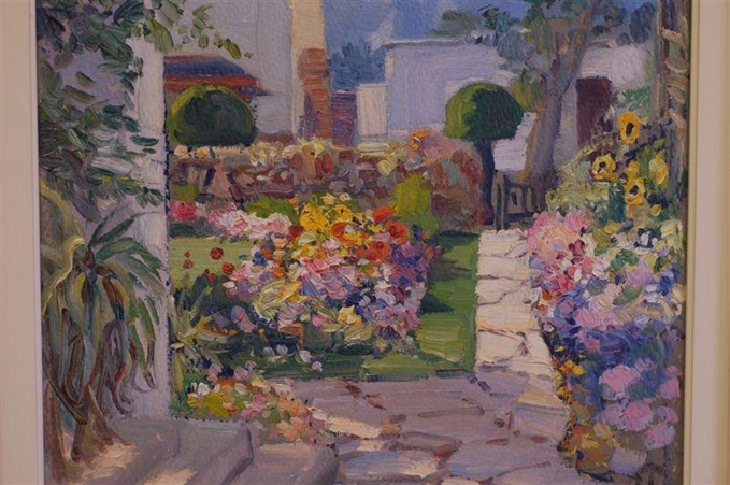
Signed lower right, oil on cardboard 24.5 x 29.5cm in the Hugo Naudé Studio. This painting of his garden looking towards Russell Street was replicated on top of his 150th birthday cake in July 2019.
in between the people standing around there. I searched in vain in the rooms inside, it was empty, abandoned, gloomily quiet. I walked behind the house to the little outside room beneath the staircase where his garden tools were stored. The door opened with difficulty, its hinges long last oiled. I step inside and the door closes by itself. In the oppressive, dusty quietness I grip his spade tightly with both hands. The cold metal beneath is worn away and shiny but the wooden handle still feels warm to me. The rake leans helplessly to one side against the window, dulled with spider webs. On the shelf lies his garden scissors with which he cut his roses and long-stemmed carnations, wet with dew, early in the mornings and delivered to us in the flat basket. I pick up the garden fork which always went with to the veld. And on that bleak sad day it was no longer necessary to irrevocably say farewell to him: I again saw the low vygies which emerge after good rains from the dead winter dust to spread over the stony ground like glowing jewels.
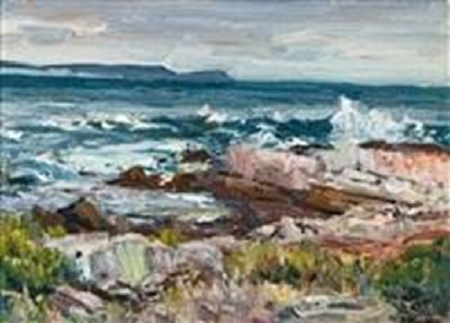
Namaqualand, signed lower right, photo from Internet.
“Wollie” continues with his memories of outings with Naudé:
From his paintings it is obvious that Oom Pieter had a very real love for nature – going out with him into the countryside was quite a revelation for he was able to transmit his enthusiasm for the surrounding scenery.
This awareness caused him difficulty when driving for he would automatically steer towards some particular scene which appealed to him! After some hazardous experiences, he decided to relinguish the wheel & acquired a driver who usually doubled up as gardener – Gawie Cupido, the subject of the “Portrait of a Gardener” which now hangs in the National Gallery was one of these gentlemen:
Portrait of a Gardener. Photo of colour reproduction in 1988 KWV calendar. Oil on canvas, unsigned & undated, 60 x 50cm in SANG/now Isiko Museum, Cape Town (donated by Adèle Naudé - see her Hugo Naudé, Fig.30, in black & white). Cupido became somewhat of a connoisseur for a painting scene with potential (Prof A.L. Meiring, “Hugo Naudé” in Our Art I published by the journal Lantern in collaboration with the S.A. Broadcasting Corporation: Pretoria, n.d., p.25).
His knowledge of the countryside of the Western Province was extensive. From his numerous painting trips he knew exactly where to picnic & where to camp. Through his many farming friends he was able to move around quite freely.
For these painting trips into the surrounding countryside, he used his caravan which he had designed & built on to a Ford chassis.
Hugo Naudé had an extensive botanical knowledge:
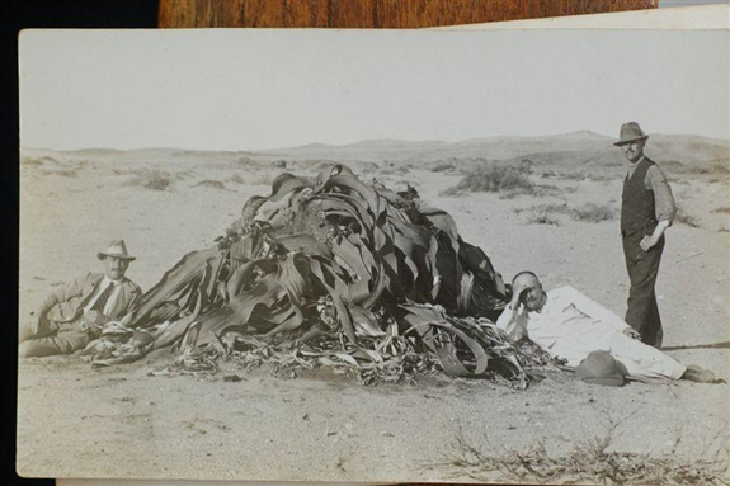
(Welwitchia plant MALE grows nowhere else in the world but in the Namib desert, S.W.A. [now Namibia]. Grows to 2,000 yrs old. Penalty of £500 for destroying one.)
During his painting trips to Namaqualand, he collected seed from the indigenous flora which he was able to cultivate in his own garden & in the “Garden of Remembrance” – this he created on Church Square in memory of those Worcester boys who lost their lives during World War I – amongst these was his nephew Wouter du Toit, the son of his sister Catherine and younger brother of Philip du Toit who went on the “Grand Tour of Europe”. Here the artist and Wouter are seen together in the photo below:
Ouma Lala and the artist’s brother, Wouter, named their son, born on 28 February 1918, after him, i.e. the author of this reminiscence: Wouter “Wollie” du Toit Naudé. Du Toit was the deceased’s surname.
During his lifetime this garden on Church Square used to be ablaze with vygies, Namaqualand daisies & many other indigenous plants. In this respect he was one of the pioneers in the culture of our indigenous flora.
In his attempts at beautifying Worcester he was frustrated at times. One incidence stands out very clearly. He was anxious to establish Lombardy poplar & Plane tree avenues along the perimeter of Church Square & actually succeeded in having some of these planted. Imagine his annoyance when these flourishing trees were removed & replaced with blue gums on the orders of some town councillor whose imagination was unable to project beyond the ubiquitous eucalyptus!
I can still hear him saying “Dreadful, dreadful” a phrase he used when irritated.
He was a competent & imaginative gardener. As to be expected the garden at the Studio was always filled with a profusion of flowers – Wistaria, bougainvillea & Traveller’s Joy over the pergolas. The perfume of petunias especially the white ones evokes memories of “The Studio” on still summer evenings.
Against the inside of the packed stone wall in the front garden he had an extensive rockery into which a fish pond was incorporated.
As a little boy I was allowed to fish for the goldfish with a piece of Marie biscuit tied to a thread of cotton – at that stage I couldn’t understand why in spite of continuous nibbling, no fish could be caught by this method!
Hugo Naudé’s generosity is well known. Having been through difficult times himself, he was always anxious to help & encourage struggling young artists. He befriended Wolf Kibel, encouraged Maggie Laubscher & many others. Although he was never a rich man in the material sense, he & Aunt Julie still managed to stretch their financial resources to enable several people to continue their University studies.64
Thanks to the activities of the artist & his wife, the cub & scout movement was firmly established at Worcester. When he went out for a day’s painting, this would turn out to be a glorious picnic for the bunch of youngsters who would invariably accompany him.
When he went camping during the school holidays he never dreamt of going alone – as young schoolboys & University students several of my friends & I were fortunate to accompany him to places like Hermanus, Onrus:
Branders, Onrus, signed “Naudé” lower right and inscribed with the title on a label on the reverse, oil on panel 24.5 x 35cm (Strauss & Co. lot 502, 6 March 2017, Cape Town).
And Palmiet Rivier – where incidentally his paintings were snapped up before the paint was dry!
Palmiet Rivier, signed “H.Naudé” lower right, oil on cardboard 24.5 x 35cm (Strauss & Co. lot 533, 5 March 2018, Cape Town).
Hugo Naudé was intolerant of any shoddiness or vulgarity both in art and behaviour and was not afraid to voice his disapproval. Being a modest man living simply he loathed ostentatiousness of any kind. He despised snobbery particularly if materialistic in nature.
As a young man setting out into the world not over-endowed with the world’s riches, he comforted me by reminding me “that only a fool despises a poor man”.
I hope from what I have said that you have been able to get a glimpse of Hugo Naudé the man – a friendly, generous personality with a great interest in the young people of the community. We growing up in Worcester were indeed privileged to have had such a wonderful friend & counsellor.65
According to N.C. Krone memory writeup on the artist, Dr C.L. Leipoldt stayed next door to them during their London visit (BC 597 A66 at UCT Libraries’ Special Collections).↩︎
Alwyn Klopper Naudé, second eldest son (1907 – 1988) of the artist’s late brother Wouter.↩︎
The SA Akademie vir Taal, Lettere en Kuns medal is at the Hugo Naudé Studio in the glass case. Photo of him receiving it is in the Brown Family Papers BC 597 E122 (UCT Libraries’ Special Collections). See forthcoming Appendix A for list of other recipients 1935-1991 in their 1992 brochure.↩︎
The artist was attended to by a “Mrs. Dr. Schonken” when he was dying according to N.C. Krone’s memory writeup (BC 597 A66 at UCT Libraries’ Special Collections).↩︎
Brown Family Papers BC 597 C39, C36, C37 & C38 at UCT Libraries’ Special Collections. Not sure who added the dates “March 19-41 and March 23/41”? The undated C39 is at the start based on its contents.↩︎
By a group of mostly young South African artists, who after returning from overseas study in 1937, questioned the conservative views of the South African Society of Artists, and supported financially struggling artists. Their first exhibition was held on 4 May 1938 in Cape Town. Selection of works to be exhibited was made by means of a secret ballot and for next 15 years they exhibited nationally (Berman, pp.209-210 & SAHO www.sahistory.org.za).↩︎
Obituary in the Cape Times “Death of Hugo Naude: S. African Artist”, by Cape Times Correspondent Sunday 6 April 1941, Worcester. See forthcoming Appendix A with photo of undated newspaper cutting.↩︎
See letter to his nephew of 27 October 1938 and those from Aunt Julie dated 6 April and 14 June 1938.↩︎
“Wollie’s” talk at the opening of the centenary Retrospective Exhibition, SA National Gallery, Cape Town on 25 February 1970.↩︎