A Glimpse into the Extraordinary Life and Work of South Africa's Pioneer Artist Pieter Hugo Naudé (23 July 1869 - 5 April 1941)
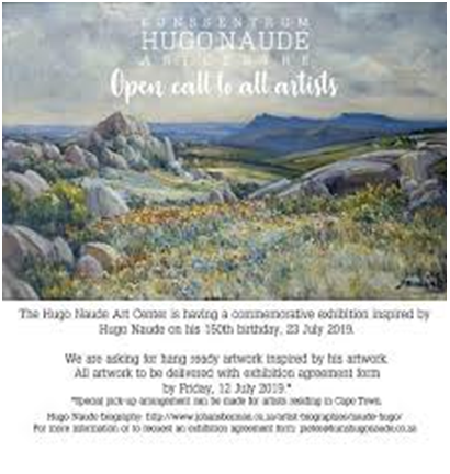
When googling “Pieter Hugo Naudé images” in 2019, there was an invitation from the Hugo Naudé Art Centre in Worcester to all artists, to submit their Hugo Naudé-inspired-paintings for a commerative exhibition on his 150th birthday, 23 July 2019:
Unable to send in a painting inspired by this pioneer South African artist’s work, but motivated to write something to honour this milestone anniversary of his birth, I decided to use the documents, e.g. exhibition catalogues, photos, talk notes, letters, newspaper clippings, sketches, documents, which my late father, Wouter “Wollie or Andy” du Toit Naudé (28 February 1918-19 May 2005)1 had carefully kept, as the basis.
The little written about this first professional South African artist seems to regurgitate questionable information, so I’ve relied on his nephew and niece’s2 memories of time spent with the artist, as well as documents to substantiate the facts.
To visit his Studio on the upper floor of the Hugo Naudé House at 113 & 115 Russell Street, Worcester, and be surrounded by around 52 of his paintings and etchings, as well as sentimental objects, such as his gramophone player, easel and palette, divan, Jerusalem Jar, is truly special. I can just imagine how memorable his centenary retrospective exhibition in Pretoria (1969) and Cape Town (1970) must have been with many more works in one place. Yet in his lifetime, Naudé never had a solo exhibition.
Googling for images of his paintings has enabled me to see over 400 on auction sites, a number one would not have been able to view in a lifetime by visiting art galleries and private collections. They can be downloaded for future viewing and zooming in on the Strauss & Co. website is like an art class where one can often see each brushstroke. An electronic gallery will be provided later so that the reader too can experience the wide diversity of subjects, the passion and energy behind each brushstroke and the exquisite beauty of South Africa’s natural environment and people. Unfortunately Strauss & Co. were not able to make images available in high resolution because “sadly, companies and individuals have been using our images to print reproductions, posters, napkins, tablecloths, merchandise, etc…This also infringes on the rights of our buyers and sellers”.3
A video of Die Kunskamer Hugo Naudé exhibition opening of 5 June 1991 was given to me4 where the art gallery owner, Louis Schachat, explained the motivation behind this most comprehensive exhibition of 71 paintings since the 1969 retrospective, to commemorate 50 years since the artist’s death in 1941. He felt the public needed an opportunity to see the full extent of his work so as to more accurately reflect on the merit of the artist.
Very few of Naudé’s paintings are dated or given titles, so a chronology and indepth analysis of his work is difficult, as Adriaan Roets discovered when researching for his M.A. UNISA Thesis Die Kuns van Pieter Hugo Naudé. Naudé’s work is unique and cannot be boxed into any of the European art –isms. Chapter 2 gives an overview of his move from his European-art-education-influenced work to a true reflection of his South African environment and provides a chronology attempt.
Pieter Hugo Naudé chose to later use his second name or his mother’s surname when signing his paintings but letters to, for example, his nephew, were signed “Uncle Pieter”.5 He was only 5 years old when she died and he spent his early school years in Franschhoek with his Hugo step-grandparents. That his Huguenot roots were significant to him is apparent later, near the end of his life in 1938, when he promised to leave paintings to the municipality to establish a Huguenot art centre in Worcester. There is therefore a chapter about his Naudé Huguenot ancestors, based on Philip Naudé’s6 research.
In conclusion a posthumous history of his legacy, outlining the tortuous moves of paintings from one building to another, out-of-sight storage, the 2011 record purchase price to the current slump, exhibitions and general reception of his work.
- Youngest son of the artist’s brother, Wouter Hugo Naudé (1 November 1862 - 4 September 1928).↩︎
- i.e. “Wollie“ and his older sister Joan Jordaan née Naudé (17 June 1909 - 6 June 1998) who wrote “Pieter Hugo Naudé: ’n Stil lewe” in Tydskrif vir Letterkunde Nuwe reeks XIV: 4 (November 1976): 29-35.↩︎
- Email of 16 August 2022 from Alastair Meredith, Senior Art Specialist HOD Strauss & Co.↩︎
- Many thanks to my cousin Hugo “Huug” Naudé for enabling me to watch this special occasion.↩︎
- See letters in Twilight Years I: 1938 & II: 1939 to 1941. ↩︎
- Son of the artist’s youngest brother from his father’s first marriage, Cloete (1871 - 1946).↩︎